BDIslam.Com
Your Islamic Education Resources
Our Pages
Some Islamic Sites
Muslim Orgs
Muslim Scholars
Islamic Software
Islamic Bookstores
Halal Food
Moon Sighting
Request
Find BDIslam helpful!!!
Please let others know. If otherwise, please let us know.
Email/Map/Weather
Bangla Newspapers
English Newspapers
News Agencies
Radio and TV
Dictionary/Library
Hi Tech
Sports
Bangla Sites
Weather
Quick links:
Qiblah Finder,
Prayer Time,
Download Adhaan
,
Learn Qur'an,
Learn Salah,
Tajweed,
Family Halaqah,and
More!

'My love is for those who love one another for My sake'
Abu Idris al-Khawalani says:
When I visited the mosque in Damascus, I saw a young man with sparkling white teeth around whom people were gathered. I saw the people referring various issues to him and accepting his advice. Upon inquiring who he was I was told, it was Mu'adh b. Jabal (the Prophet's companion).
On the following day, I went to the mosque early, and I saw he had arrived before me. And he was praying; I waited for him; whence I went up to him and said, "I love you for the sake of Allah." On hearing my words, he turned towards me and asked, "for the sake of Allah?" I said, 'Yes"; again, he asked, 'for the sake of Allah?' once again, he asked, "for the sake of Allah?" I said yes. Then he grabbed my shoulders and said, "Receive the glad tidings, for I heard the Messenger of Allah (upon whom be peace) say, "Alah, the Most Exalted and Glorious, says, "My love is established for those who love one another for My sake; those who come together for My sake; those who spend on each other for My sake, and those who pay visits to each other for My sake!"
(Ibn Abd al-Barr in his al-tamhid)
Eight Thoughts for Daily Meditation
Zayn al-Abideen, the great-grandson of the Prophet (peace be upon him), once said: Eight thoughts doggedly pursue me wherever I go:
1. That Allah demands that I fulfill His rights upon me.
2. That the Prophet wants me to follow his Sunnah.
3. That my family relies on me to provide for them.
4. That my carnal soul wishes for me to cater to its needs
5. That Satan is always whispering to me.
6. That the two scribes, who are ever present with me, are diligently recording my every move.
7. That the angel of death is waiting around the corner ready to seize my soul.
8. That the ground is ever-ready to receive my body.
Allah's power irresistible
Alp Arsalan (1026-1072), the famous Saljuk Sultan and the hero of the battle of Mazikert, was reputed for his piety, courage, and great character. At the peak of his fame and power, he was stabbed unexpectedly by a soldier he had captured. Seeing death as inevitable, he is reported to have said:
In every purpose I set out to achieve, and every army I wished to defeat, I did first place my trust in Allah and beg for His help - except at this one time in my life. For I was looking at myself from above. Surveying my massive army, I said to myself, 'Who can defeat me, and who can resist my power? If I want, I can march to the farthest point of China without meeting any resistance!' This is when death came from this hidden corner. Allah brought me down using this, His weakest of creatures! So I repent and ask forgiveness of Allah for my vanity and urge everyone in a position of power and prestige to recognize Allah's mercy and favour. For, everything they possess is only out of Allah's sheer grace and benevolence!
Imam Ghazali on the effects of dhikr
The reality of dhikr (remembrance of God) will not take root in the heart until it has been enlivened by the fear/ consciousness of God, and until it has been cleansed off the base traits of character. Otherwise, dhikr will remain as mere idle self-talk without power to exert any influence on the heart; hence incapable of repelling the assaults of Satan. This is not different from the case of a man praying to God, but feels that his prayers are not heard by God, since he has failed to fulfill the condition of prayer; likewise, one may make dhikr and yet he finds Satan is still not fleeing from his heart as he has not fulfilled the conditions of dhikr.
A person of paradise
The Prophet (peace be upon him) once stood up among his companions to address them.
"Who among you is fasting today?" he asked those assembled before him. Abu Bakr indicated that he was.
"Who among you has attended a funeral today?" continued the Prophet. Again, Abu Bakr indicated that he had.
"And who among you has fed a poor person today?" asked the Prophet. Again it was Abu Bakr.
Finally, the Prophet asked, "Who among you has visited a sick person today?" For the fourth time, Abu Bakr indicated that he had.
To this the Prophet exclaimed, "None but a person of Paradise could have attained all these virtues in a single day!"
Allah saves His righteous servants
Four eminent scholars, all bearing the first name of Muhammad*, once journeyed together to Egypt. While there, their provisions ran out, and they found themselves on the verge of starvation. Concluding that they would need to beg to survive, they decided to draw lots to pick one among them for the task. The lot came in favor of Muhammad b. Khuzaymah (known as ibn Khyzyaman, the scholar of hadith). Ibn Khyzyaman bade the others to wait until he had performed wudhu and prayed two rak'ahs. He was deep into prayer when they suddenly heard a knock at the door. Upon opening it, they saw a man with a lantern in his hands. The man proceeded to call out the names of each of the four Muhammads, one after the other and handed out to each a purse containing fifty dinars. Then he said, "The governor of Egypt was having his siesta when he saw a vision that the four Muhammads were starving. Upon waking up, he dispatched me to you with these purses, and has instructed that you should inform him when the amount runs out!"
* They were: Ibn Jarir al-Tabari, Ibn Khuzaymah, Ibn Nasr al-Marwazi, and Ibn Harun al-Ruwiyyani.
Thank you and Jazakallahu khairan for visiting BDIslam.Com!
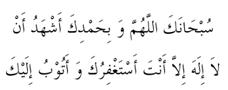
‘How perfect You are O Allah, and I praise You. I bear witness that none has the right to be worshipped except You. I seek Your forgiveness and turn to You in repentance.’